
Digital team events have made many things easier in recent years: content can be delivered flexibly, teams can be guided through stories, and points or progress can be tracked automatically.
At the same time, a problem can quickly arise: if a team event takes place almost entirely on a screen, some of what makes a great group experience can get lost.
People should talk to each other, divide up tasks, experiment together, and sometimes solve challenges with their own hands.
This is exactly where hybrid game concepts come in.
With espoto’s new Atlantic Ocean Race, we deliberately combine digital storytelling with hands-on team challenges. The app takes on the role of game master, but a significant part of the game takes place around the table and throughout the room.
Crossing the Atlantic in a conference room
Digital team events have made many things easier in recent years: content can be delivered flexibly, teams can be guided through stories, and points or progress can be tracked automatically.
At the same time, a problem can quickly arise: if a team event takes place almost entirely on a screen, some of what makes a great group experience can get lost.
People should talk to each other, divide up tasks, experiment together, and sometimes solve challenges with their own hands.
This is exactly where hybrid game concepts come in.
With espoto’s new Atlantic Ocean Race, we deliberately combine digital storytelling with hands-on team challenges. The app takes on the role of game master, but a significant part of the game takes place around the table and throughout the room.
Crossing the Atlantic in a conference room
The idea behind Atlantic Ocean Race is easy to explain:
Several teams each take on the role of a sailing yacht crew and compete in an Atlantic crossing from Gran Canaria to Martinique.
Our espoto scavenger hunt app tells the story, presents challenges, and tracks each crew’s progress. With every challenge they complete, their yacht moves a little closer to the finish line.
What makes the concept special is that the game requires neither GPS checkpoints nor a specific location. The entire format can be played in a conference hotel, an event venue, or directly at a company’s premises.
This clearly sets the concept apart from traditional city rallies or outdoor scavenger hunts.
The app leads – the team plays
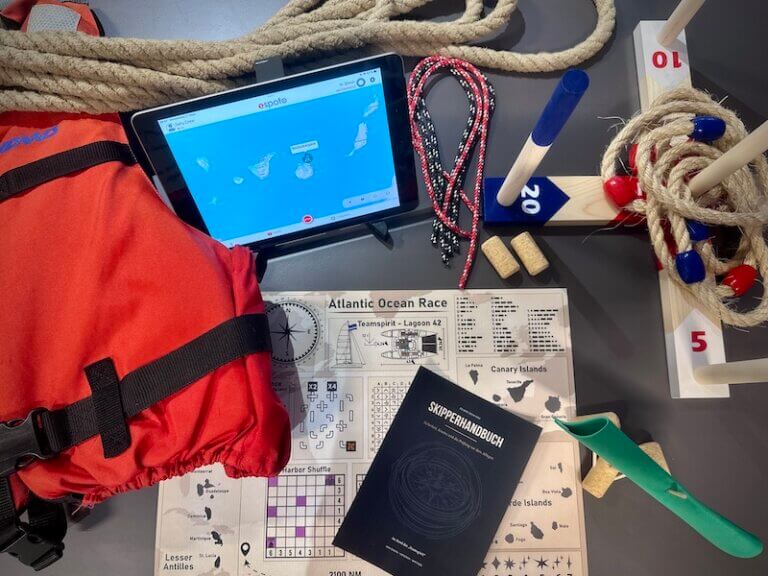
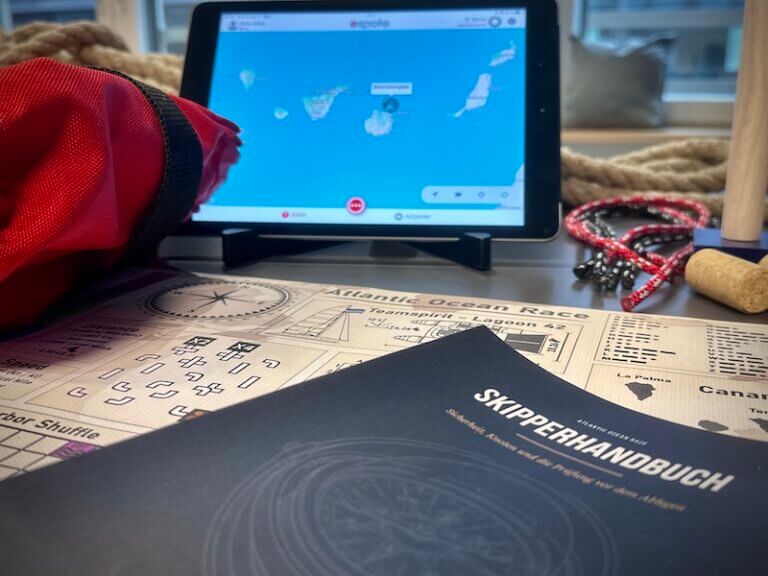
In Atlantic Ocean Race, each crew uses a tablet or smartphone. This is where they receive the next scene, information, and challenges.
But the solution is not always found on the screen.
Alongside classic digital puzzles, the game also includes real hands-on team stations. The licensing concept includes challenges involving ropes, craft materials, life jackets, and lifebuoys.
Examples include:
- tying a reef knot correctly
- building a sailing boat that actually floats
- putting on a life jacket while blindfolded
- throwing a lifebuoy as accurately as possible
- later racing the self-built boats against each other
It is precisely this constant switch between digital and physical challenges that significantly changes the dynamics of a digital team event.
The tablet does not become the center of the game – it becomes the game master.
Different challenges for different people
Another important question during development was: How can we prevent the same people from dominating the game every time?
In a traditional quiz, those who read quickly, know a lot, or enjoy calling out answers are often at an advantage.
That is why Atlantic Ocean Race deliberately alternates between very different types of challenges.
The concept includes knowledge and logic, calculation and estimation, practical skills and hands-on tasks, creativity, and organization.
While one person might decipher a Morse code message, another builds the sailing boat. Someone organizes the crew while others stage a photo or video challenge.
As a result, the composition of a team can genuinely influence how the game unfolds.
Turning points into nautical miles
When it came to the competitive element, we did not want to simply display a traditional leaderboard.
In Atlantic Ocean Race, the teams’ progress becomes part of the journey.
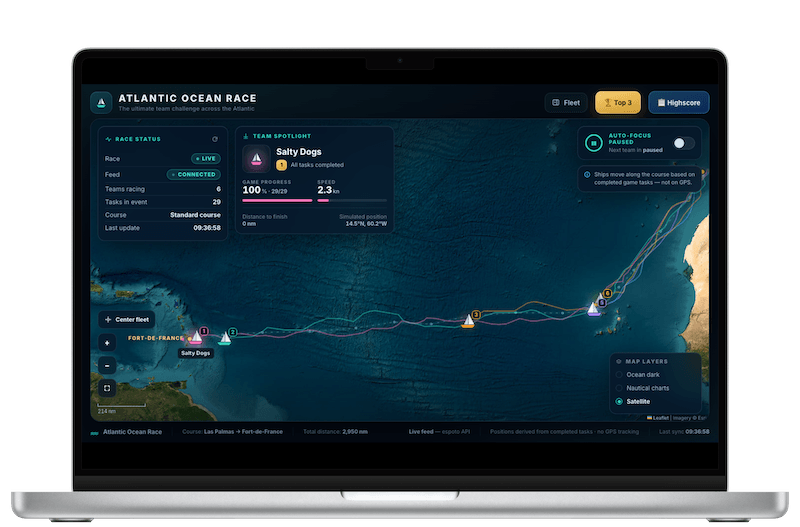
Points contribute to the ranking while each crew’s yacht simultaneously moves along the Atlantic route towards Martinique. Optionally, the current position of all crews can be displayed on a projector or large screen.
This creates a visible race in the room.
Teams do not simply see that they are in third place. They can see that their competitors are already several hundred virtual nautical miles ahead.
Especially towards the end of the game, this can create a completely different dynamic compared with an abstract points table.
26 days across the Atlantic in 90 minutes
The game’s storyline is also inspired by a real journey.
The crew first takes over their boat in Gran Canaria, prepares for the crossing, and then sets sail towards Cape Verde.
Later, they face weather problems, navigation challenges, a stopover, and eventually a storm and rescue scenario before finally reaching Martinique.
The game is therefore not simply a collection of independent challenges.
Each challenge is part of one continuous story.
From our perspective, this is one of the key differences between a digital task platform and a true storytelling game.
Why hybrid team events are so interesting
The combination of digital guidance and hands-on challenges offers some interesting advantages.
Digital systems are particularly good at delivering content individually, providing hints, calculating scores, and creating different game paths.
Hands-on challenges, on the other hand, create something different: they bring people together physically.
Someone has to collect the materials. One person holds the rope. Another reads the instructions. Two others discuss the best solution.
These may seem like small moments, but they are often exactly what creates the actual team experience.
That is why Atlantic Ocean Race does not aim to digitize as many game mechanics as possible.
We use the app where it offers real advantages – and leave the screen behind whenever working together is more engaging.
A team event without a fixed location
For event organizers, this approach offers another major advantage.
Because Atlantic Ocean Race does not require GPS check-ins, the same game can be played in a wide variety of locations, including conference hotels, production halls, cafeterias, gardens, and exhibition stands.
This makes the format suitable for occasions such as:
- conference and meeting programs
- kick-off events
- onboarding
- summer parties
- incentives
- trade shows and marketing events
These different use cases are also explicitly included in the licensing concept.
From a game concept to a ready-to-use event format
Atlantic Ocean Race is more than just a showcase for our espoto platform.
The concept has been developed so that event providers can add it to their own portfolio as a complete, ready-to-use format.
In addition to the digital game itself, the package includes print templates, a material concept, an operator manual, and training for event staff. Individual app branding is also available.
With this approach, we want to go one step further than traditional software solutions: instead of providing only the technical tools, we offer a fully developed game concept that event organizers can use directly with their own clients.
Discover Atlantic Ocean Race
90 minutes of gameplay, an Atlantic crossing, and a combination of digital puzzles, hands-on team stations, and visible competition.
If you would like to try the concept yourself or add it to your event portfolio, you can find more information about Atlantic Ocean Race on our product page.